

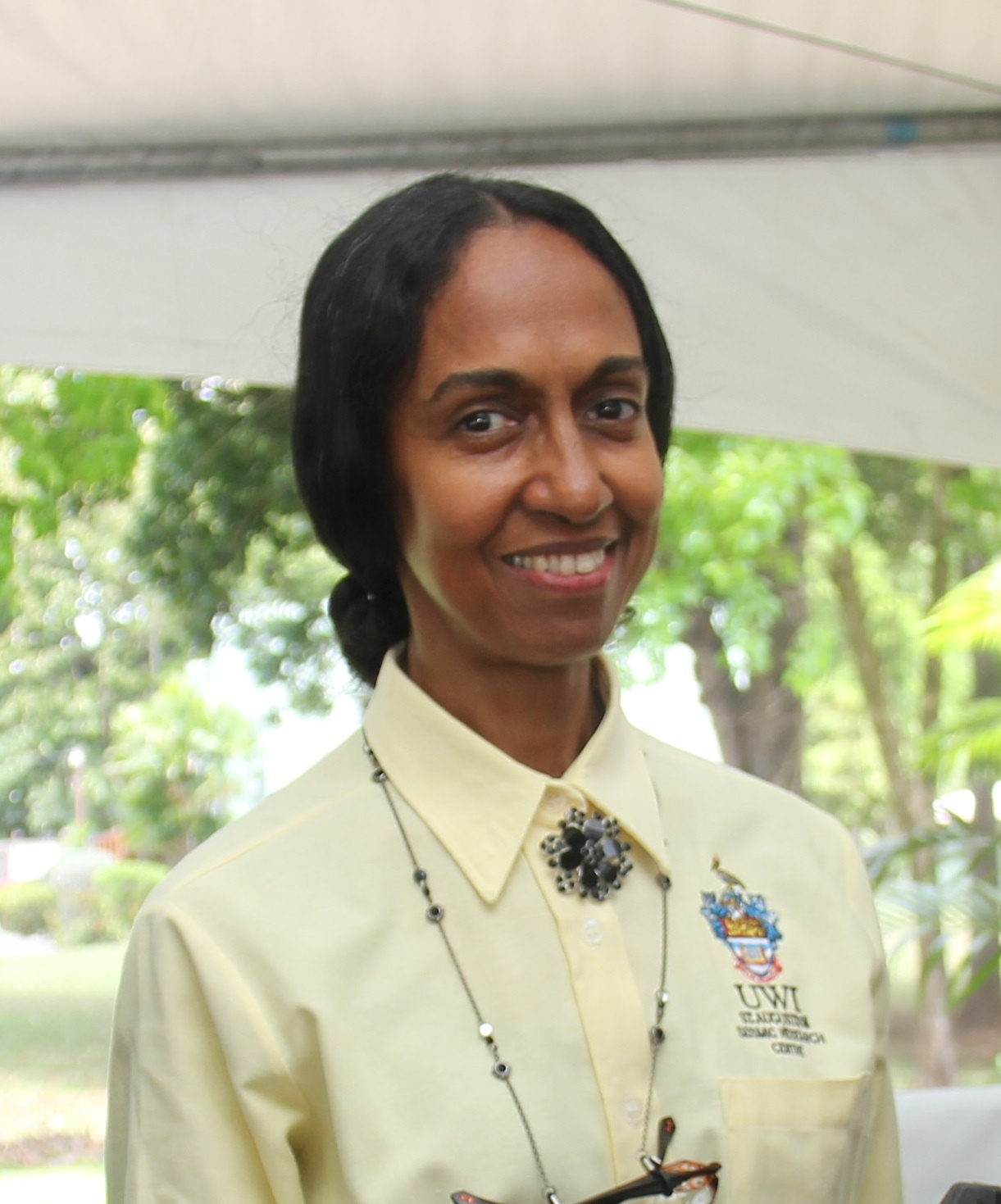
My ISC Story: A stepping stone in a most rewarding careerNotes from Dr. Joan Latchman
(Seismologist / Bulletin Editor during 1988-1990) Received: 19th May 2026 |
 |
The Arrival
The 1988/03/10 magnitude 6.3, east of Trinidad, minor damaging earthquake set the train of events in motion that led to me taking up the two-year post of visiting seismologist at the International Seismological Centre, in November of that year. The then Head of the Seismic Research Unit had shared the advertisement for the post with me, something that was completely out of character for him to do. I would not have seen it otherwise. I decided I had nothing to lose and applied. Although I had worked with seismic data for 16 years, actually being chosen for the position was highly unlikely, since, at the time, I had only my Batchelor’s degree. However, I considered that those 16 years of working in an Observatory setting, reading and processing Eastern Caribbean seismic and volcanic earthquakes and the training received from well-qualified and experienced in-house technicians and scientists, had equipped me for the position. Then, highly unlikely became reality and Anthony Hughes, the ISC Director, at that time, telephoned on 1988/08/05, reminded me of my application, asked if I was still interested and formally offered me the job by letter dated 1988/08/09, to start in November.
|
Several things had to be arranged before I could take up the position. The ISC had to apply for the Work Permit, to be collected at the British High Commission, in Trinidad, and make travel arrangements. They already had a fully furnished house rented, on Mayfair Drive, in Newbury, on behalf of visiting seismologists. Accommodation was settled. On my side, I had to advise the Head of Department that the application was successful and apply for a leave of absence from the University of the West Indies. I also had to arrange for my domestic responsibilities to be managed during the two-year absence. Finally, I had to decide on my itinerary. I would be arriving in winter and would need at least basic, suitable clothing. My Mum had passed away in February and since it was unlikely that I would be returning to the Caribbean during the two years, I wanted to visit my aunt, my Mum’s elder sister. Therefore, the itinerary took me to Barbados for a couple of days, onto New York, where a cousin guided me on appropriate coat and boots, for another two days, and then on an overnight flight to Heathrow.
Anthony Hughes, identifying sign in hand, was there to receive me at the Arrivals area, quipping that my luggage gave away that I was not a holidaymaker. Even though it was November, the weather put on a good show, with a lovely, sunshiny, although not warm, morning for the drive to Newbury. He settled my luggage in the house, at 24 Mayfair Drive, telling me that David McGregor would collect me, get me fed and brought to the office. It was a semi-detached, house, within comfortable walking distance from the train station. |
|
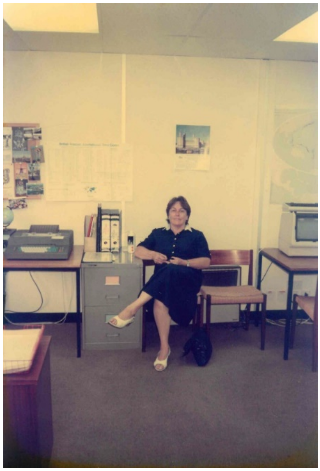 |
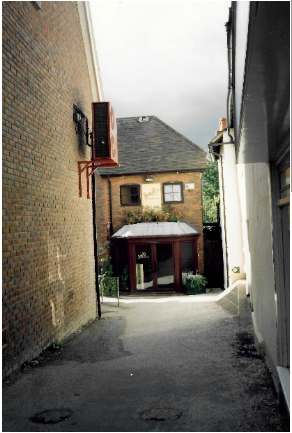
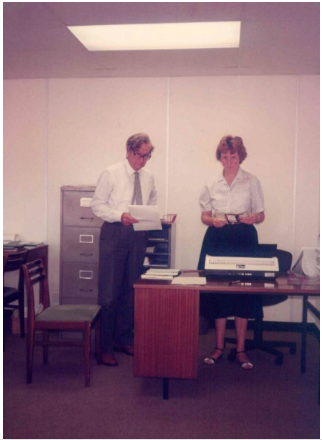
My first meal in Newbury was at Spurles Café down a little alley off Northbrook Street. It was in a beautiful setting near the bridge and along the river. En route to the ISC, in Thatcham, David pointed out the important shops I would need in the routine of life in Newbury. Back in Trinidad, my Head of Department, who was from England, had mentioned that, at one time, the ISC used to be in a castle and although he knew they had moved, the image in my mind was in that vein; somewhere quiet and away from too much hustle and bustle. Imagine my surprise to discover that it was a steel building in a modern Industrial Estate, with all kinds of traffic, including high sided lorries, up and down, and a nearby train line completely shattering the preconception! The earthquake factory is how someone once described it, Anthony jested in my orientation session with him the following day. On entering the office, a familiar drum recorder greeted me, with a signal coming from Llanuwychllyn, a seismic station in Wales. David showed me around the office and introduced me to the other members of staff. Maureen Aspinwall was introduced as the Secretary (Plate 2); I soon discovered that “Executive” was omitted from her title. She would be my go-to person to solve any challenge I might encounter. The Director’s office was upstairs and the Secretary was installed right outside his door. The other offices were downstairs. Robin Adams, originally from New Zealand, was the senior seismologist and would be the one with whom I would work most closely. He was also the incumbent Secretary General of IASPEI and had a secretary, Diana Robinson, who would come in on Wednesday mornings to assist him (Plate 3). Our office was on the left of the staircase. On entering, reams of computer printout sitting on a shelf caught the eye first. |
|
David’s office was on the right with a connecting door to the data entry office. He was in charge of all computer operations. Carol Tubby was responsible for keying data that came in via hard-copy bulletins (Plate 4). The “archive”/garage and computer room were at the back on the left and right of the kitchenette and bathroom area respectively. The offices all had large windows, which created a bright, light atmosphere, in spite of the vertical blinds. Staff members were all warm, friendly and welcoming. The next surprise for that day was that I was given a key to the building. Everyone had to have a key. Whilst I was accustomed to having a key to the office, in Trinidad, I did not expect to receive one the very first day. I also received the monthly train pass that I would need to travel between Newbury and Thatcham, when that time came. That was considered enough, having flown all night, without much sleep, so David returned me to the house via the grocery to be all set for a few days, saying that he would collect me the following morning.
|
|
Work of the ISC
The two days following my arrival were mostly spent with Anthony, who was quite the raconteur. He described with great enthusiasm the history of the ISC, providing insight on the reason that one of the two most reputable agencies for processing global seismicity, and the one considered the final authority on an earthquake’s parameters, came to be in England.
During that session, Anthony happened to mention that he was of the opinion that earthquakes in the mid-Atlantic ridge influenced earthquake occurrence in the Lesser Antilles. I found that remark very interesting since I had recently noted that the Vema Fracture zone, a feature within the mid-Atlantic ridge, is virtually directly east of Tobago, the second island in our twin-island state of Trinidad and Tobago. It became important input in my later research back in Trinidad.
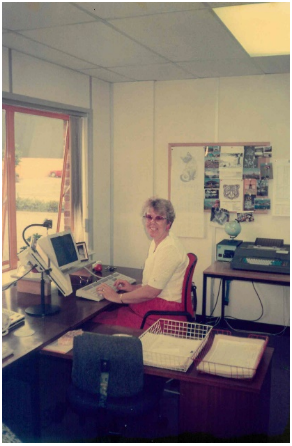 Plate 4: Carol Tubby, Data-Entry Clerk |
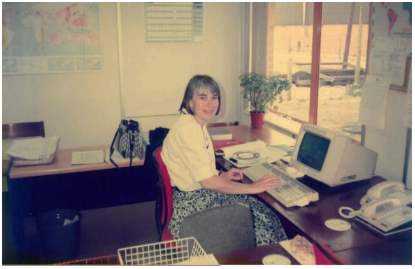 Plate 5: Anna Surguy Assistant Computer Programmer Introduction completed, it was time to get down to routine work. Robin guided me through the steps in data processing that allowed a month’s data to be processed in a month, two years behind real time. That delay was to maximise the number of stations contributing to an earthquake location by giving global agencies, with diverse access to available technologies, the time they might need to submit their data to the ISC. |
In a local, or regional, context, it is only for aftershock sequences that earthquakes occur in rapid succession. In the global context, however, the timing of earthquake activity is always like a regional aftershock sequence and ensuring that phase arrivals are associated with the correct earthquake is an important part of the data processing. Strong earthquakes, in California, in1987 and 1988 and the strong earthquake east of Trinidad, mentioned earlier, and one in China, came up for processing in 1989 and 1990 respectively, and allowed me to strengthen my understanding of the nature of seismicity in those zones. In the case of our east of Trinidad events, some teleseismic stations appeared to be on a preferred propagation path and would routinely record lower magnitude events.
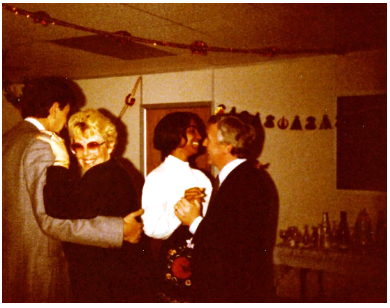
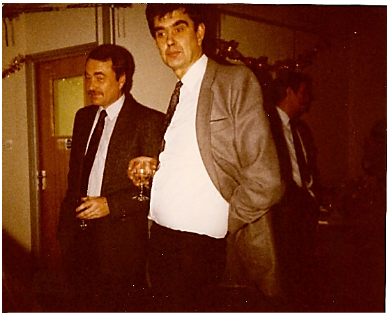
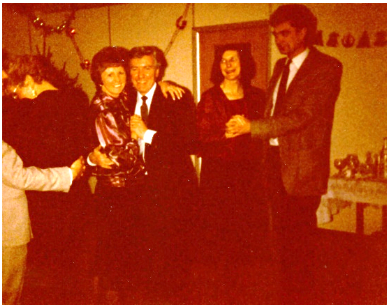
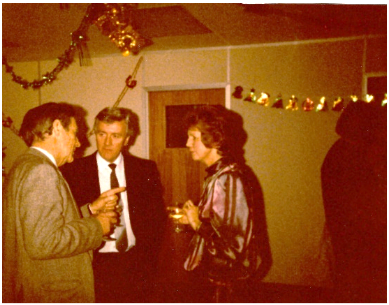
Christmas quickly followed my arrival. I described our Christmas parties at the Seismic Research Unit and suggested to Maureen and Carol that we should have one. Staff could contribute the eats and the ISC drinks. We could have music and dancing and I would take pictures and send back to Trinidad for them to see a Christmas party ISC style. The 1st floor was decorated and that was the party venue. Everyone supported the effort. I am not sure if it was to help me feel more at home, or if they were into the fun of it, but which ever, it turned out to be a lovely evening (Plates 6a-g). I was not surprised to find that no one was really interested in dancing, but they were all good sports and posed for pictures. I have cousins living in Reading and I spent such special holidays with them.
|
|
| |||
|
|
||||
|
|
||||
|
|
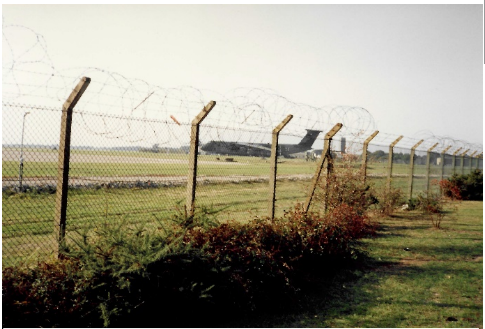
For the first few weeks, David would collect and return me home. Once I was sufficiently settled, I used the train. Many evenings, however, I would travel with Robin to Newbury. He drove along Greenham Road, which ran past the Royal Air Force (RAF)/U.S. Air Force (USAF) Base on Greenham Common. During my time at the ISC, the Greenham Common Women’s Peace Camp was at the entrance of the base. They were protesting the presence of nuclear-tipped cruise missiles at the RAF/USAF Base in the goal of nuclear disarmament. When I asked Robin how they were able to live there for so long, he said that there were people, who supported their goals, and funded the Camp. |
|
Notable Events
Mere weeks after my arrival, on 1988/12/07, the magnitude 6.8 Spitak, Armenia earthquake struck and killed at least 25,000 persons. For me, the damage and death toll were surprising because in my naïveté, I expected that, in that part of the world, the structures, especially schools and hospitals, would be more earthquake resistant. Most of the dead were children and a large percentage of hospitals and medical professionals was lost, just when they were most needed. This too helped to inform my thinking on, and fuelled my passion for, earthquake preparedness because of the potential, dire consequences for societal continuity when it is inadequate.
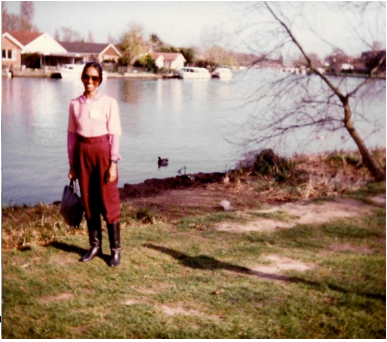
On the evening of 1989/03/13, Robin telephoned me and said that I should go outside and look at the sky. He did not say why. It was still cold, so I donned coat and boots, went outside and looked at the sky. The most glorious vision of a light show of shaded pinks greeted my eyes. In looking up, it was like being under a sky-sized circus tent. The lights appeared to be racing upwards towards the apex. It was so awe-inspiring that I did not even remember that I should try to capture it on film. I was the only one from the neighbourhood out looking up at the sky and I, therefore, assumed that this was something very ordinary for the people there. Of course, I did not think aurora borealis because shaded pinks are not the usual part of the spectrum shown in pictures of the Northern Lights. It was only the following day that I learned that it was in fact most rare, that besides Robin no one else at the office had seen the lights. The only reason that Robin had caught them is because he had gone outside to feed Felix, their cat, and knowing that it would be something thrilling for me coming from tropical latitudes, shared it!
|
|
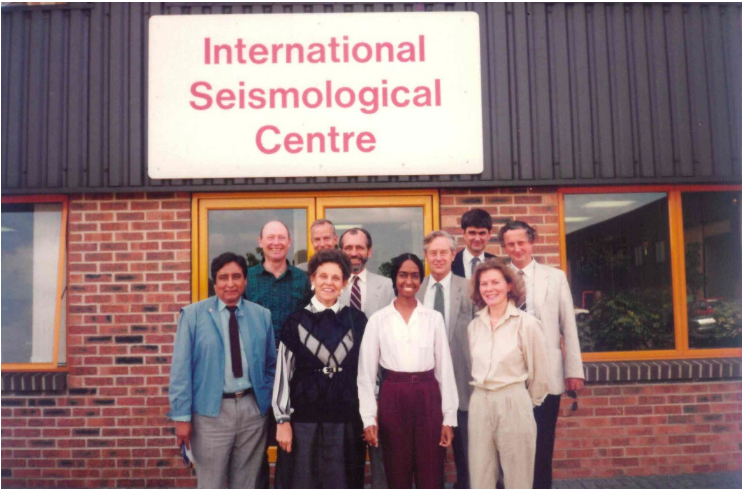
Plate 9: (Front L to R) Dr. Jesús Berrocal (Brazil), Prof. Nadia Kondorskaya (Russia), Joan Latchman (visiting seismologist ISC, Trinidad and Tobago), Olga Odintseva (Translator Russia) , Back row l to r) Dr. David Denham (Australia), Prof. Durk Doornbos (Norway), Dr. E. Robert Engdahl (United States), Dr. Robin Adams (seismologist ISC), David McGregor (seismologist ISC), Anthony Hughes (Director ISC) |
Just two weeks later, Saturday evening 15th April, turning on the TV for the first time that day, I learned of the disaster that had unfolded at Hillsborough before the football game. A series of unfortunate decisions led to a crowd crush that claimed the lives of 97, mostly Liverpool, football enthusiasts. I was stunned and heartsick at the images. This too played into future advice on earthquake preparedness and response.
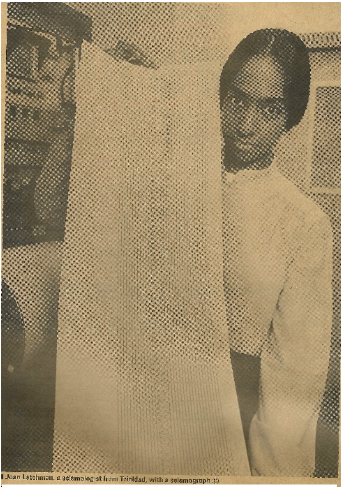
|
The Loma Prieta earthquake on 1989/10/17, in California USA, was another event that would set global news buzzing, because of the level of damage and the death toll. Highways and Freeways collapsed causing many of the 63 deaths. Were it not for the 1989 World Series on that day when many people had left work early to be at the stadium, or watching the game on television, the death toll would likely have been much higher, because the earthquake occurred at 5:04 p.m. (local time) at the height of normal rush hour traffic. Yet another insight that would feed into earthquake awareness and preparedness.
It is incredible that I had lived all my 35 years in the Eastern Caribbean and had never experienced a hurricane first hand. However, within the two years I was in England, we were sent home from work, on 1990/01/25, because of a hurricane that was forecast to strike England. There was very little associated rain, but the wind was strong enough to topple some large trees, in Newbury. The following morning, the trains were not running and I had to walk up to David’s home for a lift into work. |
The culture
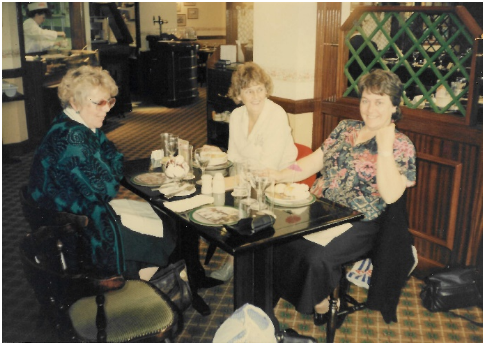
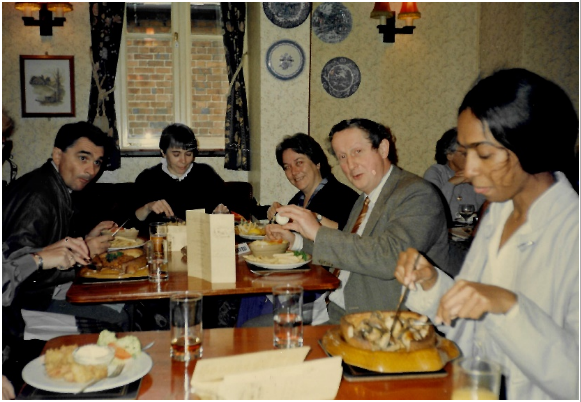
Learning about the culture began with being exposed to pub lunches. In the first year, Maureen, Carol and I would have lunch every month at one of the pubs in and out of the area. I had the opportunity to try the meals we would hear mentioned in British films we would see on TV. It is a running joke on such shows that English food is bland and unimaginative. However, I was pleasantly surprised to find that that was not in fact the case. Whilst pub lunches are by no means, “fine dining”, the food is very tasty. Certainly not bland. I had a meal described as “chili” for the first time and it was the spiciest meal I had ever had, up to that time! The desserts were delightful, the most memorable being “death by chocolate”. In addition, of course, I cannot neglect to include Yorkshire pudding, which I quite enjoyed.
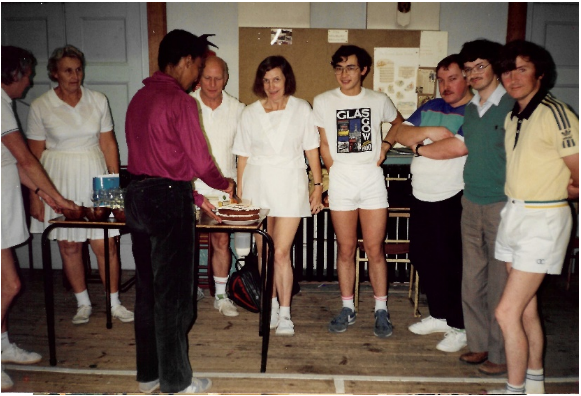
In chatting with David, I mentioned that I used to play badminton at school. He said that his wife, Pat, was Captain of a club at their church, the United Reformed Church and he was sure that I could join them should I be interested. They played on Thursday evenings. The age spectrum was wide with a teenager and his mum, young men in their 20’s to mature couples. I fell right in the middle. I thoroughly enjoyed being a part of their sessions and I played with them, on Thursday evenings, throughout my stay.
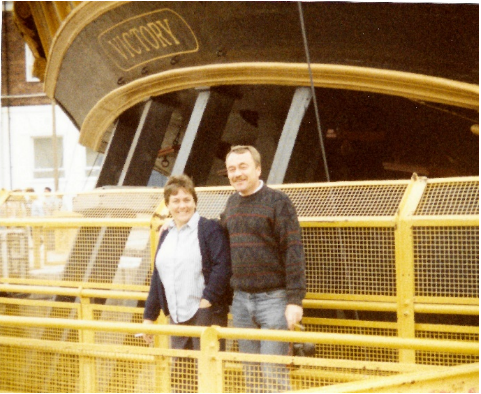 |
Whilst in England, I also wanted to experience the famous West End and shows that we would hear about in the news. Since I would have to do this on my own, after seeking guidance from Maureen, Carol and David, I found that Swansdown Coaches had a schedule of trips into London for the Musicals. The coach would leave from the Corn Exchange and return there, from where I would take a taxi home. The two most memorable were Miss Saigon and Les Misèrables. In talking about how smoothly it was all going, Carol’s sister, Audrey, who was interested in the shows, but never attended because she did not have company, joined me for such outings. Maureen and Robin would include me on sightseeing tours, along with Sunday lunches, to areas of special interest, such as Winchester, which included a visit to HMS Victory in Portsmouth (Plate 11), Bath and Lacock, to name just three. |
|
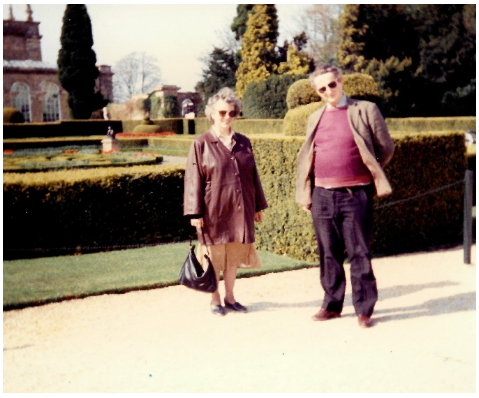
I also enjoyed dinner with David and Pat, Carol and her family and Robin and Thelma. I met Carol’s pet kois, which she kept in a large aquarium in her living room. It was from Carol I learned that fish recognise people and would leave where they are in the tank and swim over to greet them. Visits with Anthony and Lucy involved the entire weekend, because they were all the way in Oxford. Their home, a listed farmhouse, had a very familiar feel about it. I finally put it down to the English novels I used to read as a child. Anthony was a bell ringer at his church and I attended a Vesper Service with them during one of my visits. They also took me to visit Blenheim Palace, which was one of their favourite haunts (Plate12). Visiting stately homes is a traditional English pastime. During our visit, they were preparing for an event that evening. We were allowed to walk by the dining room and see the staff laying the tables. The china cabinets were part of the display. It was all most grand. |
|
|
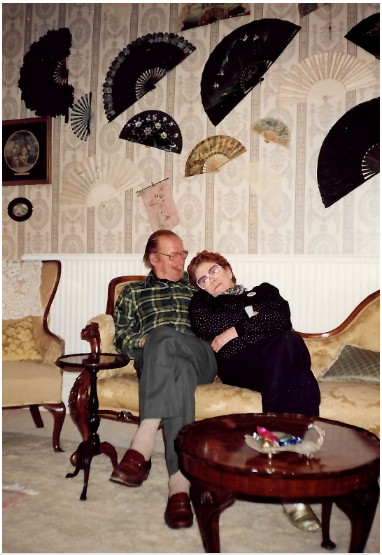
In mid-1989, mere months after arriving in England, the landlady of the house rented for the visiting seismologist, on Mayfair Drive, decided to downsize and return to living there. Maureen and I, therefore, had to go house hunting. The available options and rates were most enlightening on the challenges of affordable options. In the end, we found a spacious, warm, clean basement apartment on the opposite side of Newbury, at 11B Donnington Square. The three-storey Georgian house was owned by Derek and Margot Needham. Derek was a retired doctor and Margot used to be an actor (Plate 13). I had to be vetted by their family before she would accept me as her tenant. This involved having dinner with the family, their two sons and the sons’ partners. It was a delicious meal and delightful company. Her family gave their stamp of approval and I moved in.
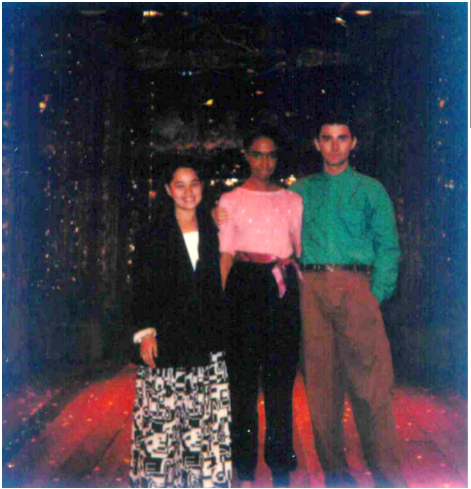
Needless to say, I took the opportunity to have a polaroid picture taken with them (in very poor lighting) (Plate 14). Although, Monique was not the leading lady when I saw it. At that time, the leading lady was Leah Salonga. |
|
|
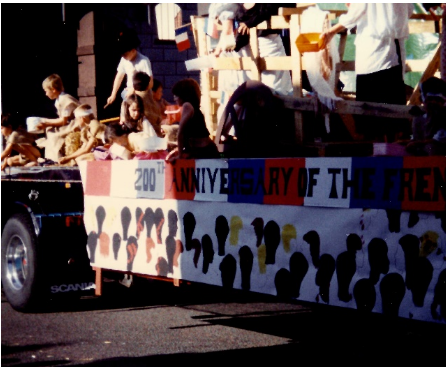
The Newbury Carnival, in July, was another cultural highlight. There was a street parade and the Watermill Theatre had their own special activities. The street parade was very different from the Parade of the Bands for Trinidad and Tobago carnival. Those in costume, in Newbury, rode on flatbed trucks (Plate 15), whereas, in Trinidad and Tobago, the revellers would jump along the parade route to the rhythm of calypsomusic.
|
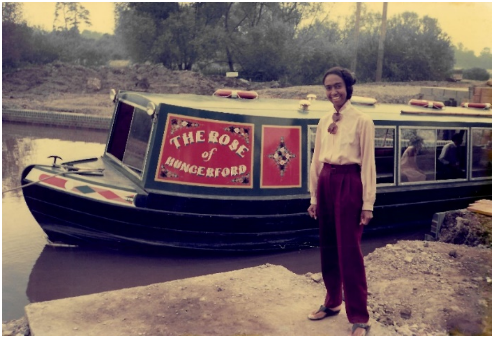
Canals are important in England, with a long and interesting history of travel and trade between towns. The Kennet and Avon canal, in Newbury, adds a special charm to the area with the many varieties of waterfowl found associated with it. On 1990/08/08, the Kennet and Avon canal was reopened to navigation. The restoration had been on-going for several decades and so it was a significant event, which David brought toour attention. We, therefore, took the opportunity to be a part of the history and walked down to the canal to take pictures. We captured some with The Rose of Hungerford as backdrop (Plate 16). |
|
Life in General
|
|
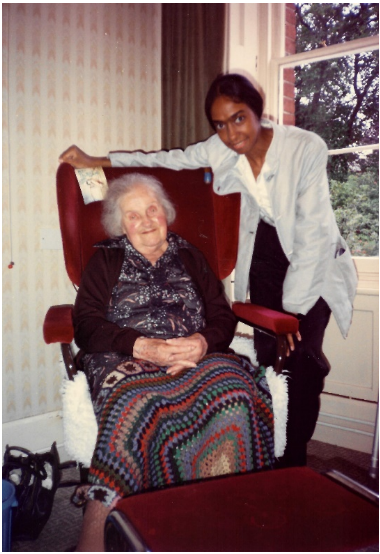
One evening upon returning from visiting Mrs. Talbot, the daughter of one of those neighbours came over for a visit. Her name was also Joan. She had married and lived in Canada for decades, until her husband passed. She asked if it would be all right for her to visit me sometimes, because she missed the diversity in Canada and was so happy to find that I was her neighbour. She did have a lung condition and had difficulty breathing. She gave me her telephone number and asked if I would call her sometimes. I did call her, chatted a little and learned that she was very unwell. The next time I called, I was told she was unavailable. I also tried to visit after I moved to Donnington, but was not allowed to see her.
In 1989, Robin received a letter from a young man from Czechoslovakia seeking a pen pal to practise his English. Robin passed the letter to me. I tried to get David to see if his daughters were interested in having a Czech pen pal, because they were closer in age to him. They were not. . I decided to write the young man to see if he would be interested in having a Trinidadian pen pal instead, intending to put him onto my niece. He was indeed interested, said that he would be happy to write to me and we continued to keep in touch over the years, as he progressed in his career and eventually moved to Australia.
The Stationmaster, a more mature gentleman, at the Newbury train station got to know me as I collected my monthly train ticket from him. He seemed genuinely very friendly and pleased to greet me every month. In late 1989, a British Rail strike led to a loss of four travel days for commuters, which British Rail reimbursed. In my case, one day was covered on one month’s ticket and the other three on the following month’s ticket. For that second month, the Stationmaster was sure he should add four days, although I kept telling him it was only three. He finally accepted my calculation. I expect that interaction served to help him better remember me. At the end of my contract, when I collected my final ticket, I told him that it would be my last ticket because I would be returning home. He asked me “why?”, said that I would be taking the sunshine away, wondered why those they would like to leave, do not and those they would like to stay, leave. He then opened the window to shake my hand. I found it kind of him to express such sentiments, especially for the usually conservative English.
The day following the Easter holiday, 1990/04/17, I found that I was feeling vaguely unwell. In spite of that, I prepared for work as usual, walked to the station, travelled on the train, and walked up to the office, with the vague feeling becoming more and more distinct. After a short time, it became clear to me that I was too ill to work. I told Maureen what was happening and she returned me home. That began two weeks of having to be in bed and unable to hold food down. Both Margot and Maureen tried on separate occasions to assist with a meal, but the bug was stronger than their efforts. When the doctor visited, she said that I had likely contracted a virus, to which I had never been exposed, hence the severe impact. Once I could eat again, Anthony would collect me on mornings. He would also take me to lunch sometimes. I speculate that it was because I had lost so much weight and I guess he felt that he needed to get me fed, so that I would not look too starved by the time I had to return home. It did not take too long for my full strength to return and I could resume my normal routine.
My 1989 holiday took me to Canada to celebrate the 100th birthday of our maternal great-uncle. It was my first visit to Canada and the first time I was meeting him. Our uncle was mentally sharp, with clear memories that allowed him to make associations and amusing comments. I kept thinking that it was fortunate that he lived to his 100th birthday, or I might never have met him. A visit to Niagara Falls was top of the sightseeing list. I had hoped to use my 1990 holiday time to visit the former Soviet bloc countries to see what they were like before they became westernised. However, the cost of the visas was more than the cost of the coach tour and I finally chose a tour of southern Italy. The original one chosen was in the spring, to take advantage of the better price. The tour company advised that I needed to have a visa for France. I went into London and got that visa. I did note that the tour would be starting from Ostend. I had never heard about that city and assumed that it must be in France. Just before the ferry docked in Ostend, I heard another passenger mention Belgium. This made me very nervous, because I guessed that I most likely needed a visa for Belgium. When asked for my visa, I showed them the one for France. The officer said that I needed one for Belgium. I asked if I could get one at the port and he said no, that it could only be done at the Immigration Office in town. Although the tour was not spending any time in Belgium, just driving through, the officer would not allow me to leave the port. I was held and returned to England on the next ferry. The purser, on the ferry, was very kind to me, seated me at the front of the cabin, away from a group of football enthusiasts on their way back to England from a match in Belgium. He checked on me often to ensure that all was well. It appears that the football fans spotted me only when we had to disembark. They did hurl a few heckles, but more good natured than vitriolic. I did not encourage them by responding; they lost interest and went on their way.
We arrived in Dover very early in the morning before any of the tour agents were at their desks. I had to sit in one of the waiting areas and try to get some sleep. When cleaners began arriving, I got myself ready for the day and waited for tour agents to arrive. Once they opened the counter, they advised that I would have .to wait there all day for the next coach returning to London. In the end, the company accepted that they were at fault for not advising me that I also needed a visa for Belgium and offered me a summer tour at no extra cost. In the end, it all worked out better for me. On the summer tour, in July, there were three girls about my age: one from Calcutta, one from Sri Lanka and one from Hong Kong. We gravitated to each other because we were all travelling without family. Everyone else on the tour was English and with members of their family.
|
The Farewell
|
|
|
|
It is everywhere, it seems, especially in Europe, the tension between the supporters of opera and musicals is indeed real. Margot said as much when one day I mentioned that I was going to a musical, “Oh! That is not real music”. Opera is considered the pinnacle of musical expression, whilst musicals are viewed as the poor relations. Anthony may have considered that my cultural experience was lacking and he and Lucy arranged for me to accompany them to a ballet and opera. They arranged it such that I stayed with them the last two nights before my flight out, so that we could attend performances, one on each evening. I went into work with Anthony the day between. Anthony was a very kind and thoughtful boss to me as he worked, in general, through Maureen to make my time at the ISC as comfortable as possible.
I had planned to bring in “sticky buns” on that last day, but with all the excitement, it completely slipped me. It was mentioned to one of the regular ISC visitors, John Young from Blacknest that I would be having a little farewell sweet treat and that he should drop by. He did drop by and said the farewells, but without the treats. I got the girls to promise to make it up for me and sponsored the treats for his next visit.
Epilogue
My time at the ISC remains one of the big blessings in my life. Things learned were important factors in my later studies. Robin helped in getting one of his colleagues to review the first manuscript, for which I was first author and was a reliable read for subsequent manuscripts. I did go on to eventually get the Ph.D., taking a very scenic route to get there, being finally awarded it 2009, having completed it in 2003. Maureen, Carol, David, Robin and I continue to write each other regularly and keep up with life’s adventures. Anthony and I updated more briefly at Christmas. Margot and I also continued to share annual updates, until she passed. Her daughter-in-law kindly wrote and updated me afterwards.
In October 1997, the UNESCO sponsored Fourth Workshop on Non-Linear Dynamics and Earthquake Prediction brought me to Trieste, Italy. I took the opportunity afterwards to visit England and Maureen put me up for the days I spent in Newbury, using her home as my base for revisiting my Newbury haunts. I did try to see if Mrs. Talbot was still at the Elder Care facility at St. John’s Church, but could not get a clear answer on how things had gone with her over the years. . Anthony arranged for lunch one day, and David and Pat, dinner one evening. It was a wonderful visit with friends. In April 2004, Maureen and John visited Tobago, came across to Trinidad for the cricket and stayed with me. Unfortunately, the cricket was rained out. They did have the opportunity to get in some sightseeing before returning to Tobago. It was a lovely time and visit and a great opportunity for them to get some insight on life in Trinidad and Tobago.
|
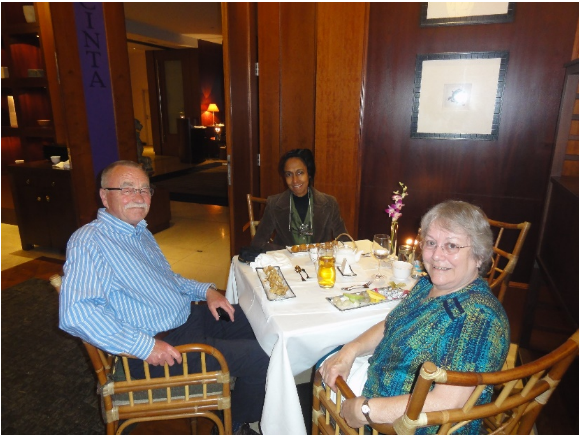
In 2015, the SRC became a member of the ISC. Based on my ISC connection, I was the designated representative. The IUGG Conference that year was held in Prague, Czech Republic. I decided to attend to present some of my work. I hoped that my Czech pen pal would be visiting his homeland during the period, which would give us the opportunity to finally meet in person. That year was also the 50th Anniversary of Governing Council meetings, and it was held as part of the IUGG Conference. As such, I was able to attend the Governing Council meeting. Maureen was part of the ISC delegation and we arranged to have dinner together one evening (Plate 21). My pen pal was indeed back home during the period and he took the opportunity to show off some of the less frequented, interesting sights in Prague. It was a walking tour. When I remarked on that fact, he said that Prague is not very big and everything to see is within walking distance. |
My ISC Story continues on a personal note as I keep in touch with friends from that time. Professionally, we have maintained the ISC-SRC connection with the new Director, Dmitry Storchak.
Other stories on the ISC history
